

We’re happy to answer any questions you might have, with no commitment to proceed with treatment.
Francis’ Plagiocephaly
Successful helmet therapy results for Francis and his parents
- Patient name: Francis
- Treatment: Plagiocephaly treatment
- Age: 3.5 months
- Travelled from: United Kingdom
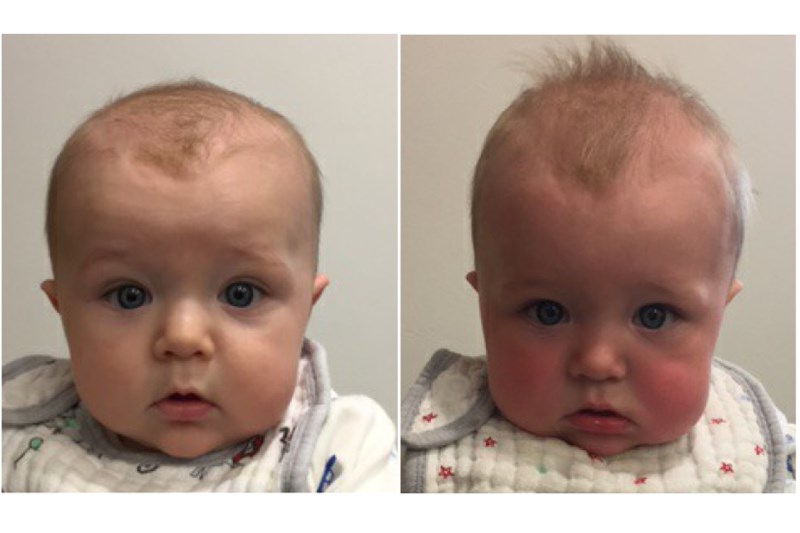
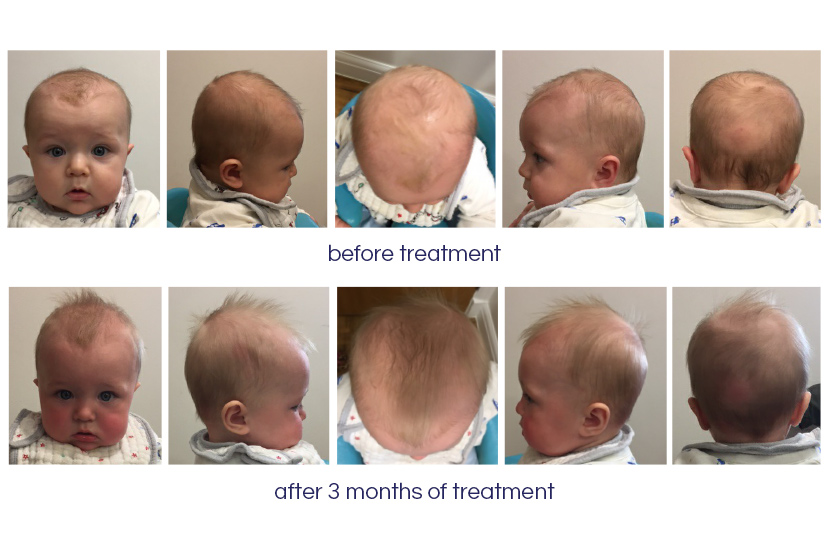
We love being able to share success stories from helmet therapy. Senior orthotist Sally Hews talks to us about baby Francis’ plagiocephaly journey and what you can expect from flat head syndrome treatment at the London Orthotic Consultancy:
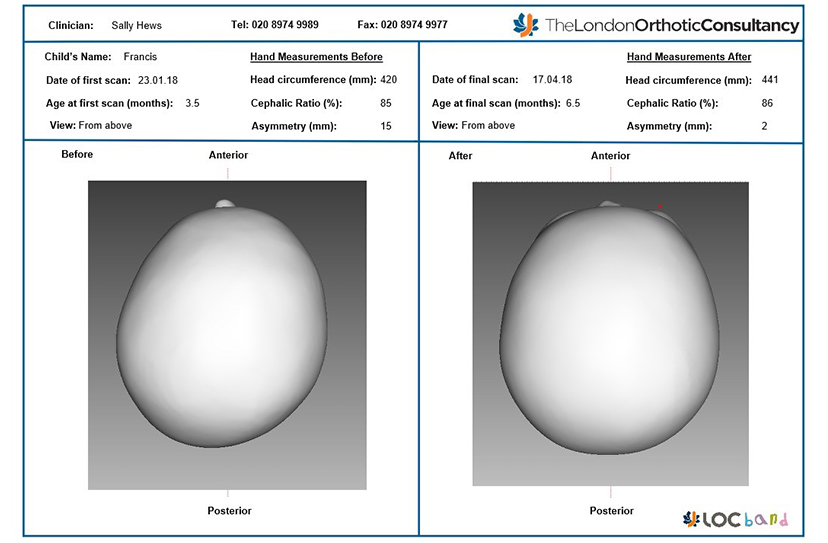
“Francis came to see me in Harley Street with his parents when he was almost 4 months old, his parents had noticed his flat head shape when he was 2 months and began repositioning him almost immediately. He favoured sleeping on his back turned to the right but not exclusively. At such a young age his head could easily be turned during sleeping as is recommended when doing repositioning, however, his parents did not see any improvement with his head shape. They were aware of cranial remoulding helmets and were quite relaxed about moving forward with treatment once his plagiocephaly was confirmed as severe. He had some flattening at the back of his head and also some facial asymmetry.
If you are worried about your baby’s head shape, you can use our online flat head diagnosis form for a fast, free and confidential clinical opinion from one of our orthotists. Your first appointment, should you need one, is also free.
Related Video
-
This is very much dependent on how fast your baby is growing. The faster the growth, the more frequently your baby will be seen so that the helmet can be adjusted. In general, reviews will happen at two to four-week intervals.
-
The price of treatment covers:
-
Yes – All babies that have completed their course of treatment with us have achieved a measurable improvement in head shape. However, you don’t have to take our word for it. Recent independent research conducted by a University Hospital in Germany has endorsed the treatment for babies with moderate or severe plagiocephaly. A larger, retrospective study has just been published that found complete correction was achieved in 94.4% of babies treated with helmet therapy. The results were conclusive: repositioning achieved acceptable correction in 77.1% of cases, but 15.8% were moved onto helmet therapy because re-positioning was not working. Meanwhile, 94.4% of the infants who started in the helmet-treated group achieved full correction, as did 96.1% of those who were transferred from the repositioning group into the helmet-treated group. Further information can be found on our Plagiocephaly Research page.
-
If your baby has a temperature or a fever due to illness you must remove the band. The band can be put back on once the temperature has returned to normal.
-
The optimum age for treatment is between four and seven months. This is because the skull is most malleable at this age and improvements to head shape tend to take less time and are more dramatic. That is not to say that helmet therapy should be ruled out if the baby is older than seven months. Routinely, babies up to the age of 16 months can be treated very successfully. The cut off age is around 18 months when the fontanelles (soft spots on the head) are no longer malleable. As babies grow and develop at different rates, it is always worth checking if you are not sure. There have been cases where a baby’s fontanelles have not fused yet by the age of 18 months, who have achieved successful, but less-marked results with cranial remoulding therapy.
-
Torticollis is a condition in which a tight or shortened muscle in one side of the neck causes the head to tilt or turn to one side, resulting in the infant resting its head in the same position. In 2013, we analysed the data from all first appointments in our Kingston clinic and found that 20% of the babies examined had some kind of neck condition that was causing head immobility.