

We’re happy to answer any questions you might have, with no commitment to proceed with treatment.
Benjamin’s Scoliosis brace
11-year-old Benjamin was diagnosed with adolescent idiopathic scoliosis and travelled to London for treatment. X-rays revealed a right-sided thoracic curve with a Cobb angle of 49 degrees.
- Patient name: Benjamin
- Treatment: Scoliosis treatment
- Age: 11
- Orthotist: Anna Courtney
- Travelled from: Philippines

LOC’s same-day service for scoliosis bracing offered a solution for 11-year-old Benjamin from the Philippines.
On the 5th September we were contacted by the family of a 11 year old boy who had recently been diagnosed with adolescent idiopathic scoliosis. His X-rays revealed a right-sided thoracic curve with a Cobb angle of 49 degrees.
Initially, Benjamin was assessed remotely by video link by Anna Courtney, head of LOC’s scoliosis team. At his age and with that severity of curve there is almost 100% chance of progression. It was clear that Benjamin would benefit from LOC’s bespoke scoliosis brace to reduce his curve and prevent the need for invasive surgery at a later date.
There was just one problem, the family lived in the Philippines. Naturally, Benjamin’s parents did not want to take him out of school for too long nor did they want to commit to travelling to and fro constantly. LOC’s unique scoliosis service provided the ideal solution.
The family arrived in the UK on the 3rd October for a 90-minute consultation with Anna at LOC’s headquarters clinic in Kingston. The consultation confirmed the decision to provide Benjamin with a bespoke brace. LOC’s scoliosis brace works in three dimensions to reduce the curve. During the day, Anna and LOC’s in-house manufacturing team modelled and then produced Benjamin’s brace so that it was ready to be fitted in the afternoon.
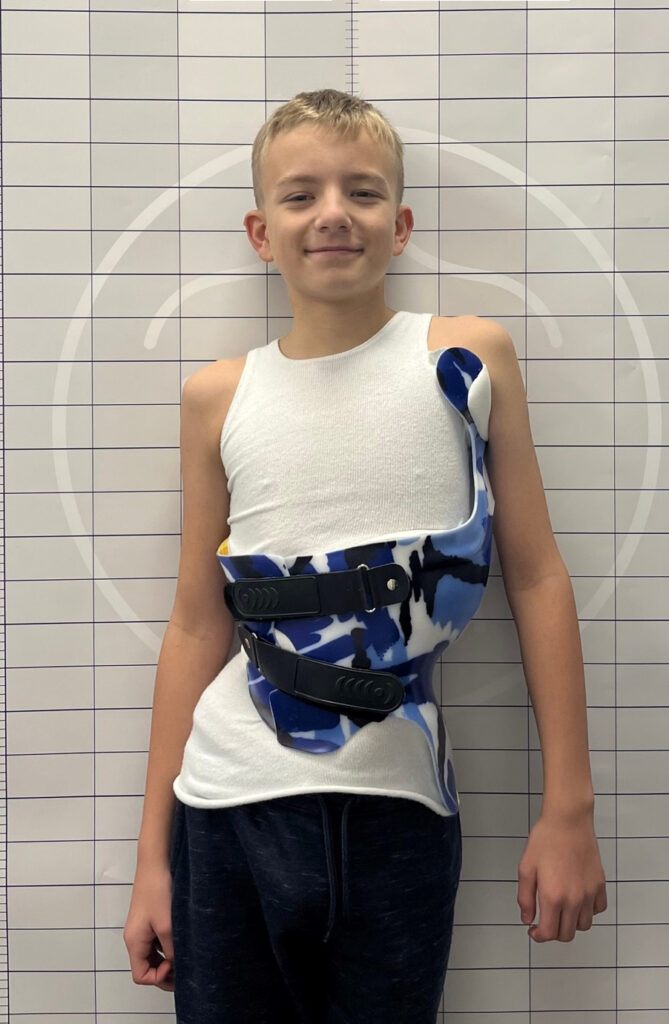
Three dedicated scoliosis physio sessions, based on Schroth principles were arranged with our partner company Scoliosis SOS for the few days the family were in England. For optimum results Benjamin will need to follow a detailed exercise programme when he is back in the Philippines.
Before the family returned home, LOC arranged for a new scan to be taken at the European Scanning Centre. This in-brace scan showed an 80% correction of Benjamin’s curve.
In summary: Benjamin was assessed and fitted on Monday, reviewed Tuesday, in brace data collection/ EOS/ x-ray on Wednesday and final brace adjustments on Thursday. This process would take two and a half months elsewhere. LOC is in the unique position of being able to provide this complete service in just four days. This treatment package is available by prior arrangement for all adolescent patients not just those from overseas.
If your child has recently been diagnosed with Scoliosis or you think they are showing signs of the condition, please contact us.

-
Scoliosis is a condition where there is an abnormal curvature of the spine. It is a three-dimensional condition with deviation of the vertebrae in the sagittal, coronal and transverse planes.
-
The simple answer is no. Scoliosis is not hereditary, there is no single known gene responsible for the condition.
-
Most of the patients LOC see have what is termed idiopathic scoliosis – which means that there is no known medical cause for the condition. What we do know is that scoliosis tends to occur during periods of rapid body growth and adolescents account for over 80% of all diagnosed cases in children.
-
Scoliosis affects 2-3% of the population. According to the NHS, around three or four in every 1,000 children will require treatment for scoliosis. It is most typically seen in children between the ages of 10 and 15.
-
In terms of an official diagnosis, scoliosis is confirmed with an x-ray, which is typically followed up with an MRI scan. A key determining factor that is used when proposing a treatment pathway, is what is known as the Cobb angle. This was invented by Dr John Cobb in 1948. It is now the standard measurement to determine and track the progression of scoliosis. A Cobb angle describes the degrees of deviation from straight in the spine. This can be measured by our clinicians, so please feel free to send x-rays to us for assessment.
-
There are visual clues that a parent should be aware of: See our visual signs and symptoms of scoliosis post for more information.