

We’re happy to answer any questions you might have, with no commitment to proceed with treatment.
Beck’s Scoliosis brace
At the original diagnosis Beck had a Risser score of 0 (meaning he had a lot of growing to do), he is now Risser 4 which means he may only have to continue wearing his brace for a couple of years during which time we would expect further improvement and then his scoliosis treatment will be complete with no need to resort to surgery.
- Patient name: Beck
- Treatment: Scoliosis treatment
- Orthotist: Anna Courtney
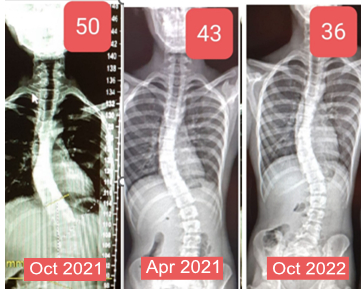
Our son’s registrar at RNOH said they were the best results he had ever seen from bracing treatment for scoliosis
Beck was diagnosed with idiopathic scoliosis by chance last year. He was chatting with his mum (Donna) at home and looking a bit glum, when asked what the problem was, he explained that he was not looking forward to his Science and Arts lessons because he had to sit on a stool and that made his back really hurt. As Beck was due to see his GP the next day for the routine removal of a wart, Donna thought she would ask the GP to look at his back. Beck was immediately referred for an orthopaedic appointment at St. Peter’s Hospital, Ashford where his X-ray revealed he had a Cobb angle of 45 degrees. Donna was shocked when she saw the image: “I knew his spine should not look like that”. The consultant told Donna that Beck’s condition was so severe he needed to urgently refer him to the Royal National Orthopaedic Hospital (RNOH). A further X-ray was taken and the Cobb angle was now 50 degrees. It is accepted protocol to recommend surgery at this level of severity and certainly, that was the immediate view of the spinal consultant Beck saw.
Donna as she admits was rather emotional at this point: “Nobody is going to put my son under anaesthetic”. She felt that as Beck was in no pain whatsoever and had no mobility issues and indeed no very noticeable physical symptoms, she was very anti-taking the surgical route. As a part compromise, it was agreed that Beck be fitted with a Boston brace which is the standard brace used by the NHS to slow the progression of a scoliosis curve.
There were some practical problems with the brace as it is unfastened/fastened at the back and cannot be done by anybody unaided. This had real mental implications for Beck as he had to ask teachers at school to help him take it off for games and then put it back on, he also could not sit on the loo wearing it. Donna hit the internet: “I thought there must be something better than this”. And this is how Donna found LOC. “LOC was recommended positively on several Facebook groups as having a brace that reduced scoliosis curves.”
Beck was seen by Anna Courtney, LOC’s lead scoliosis clinician, on 22nd February. Donna was impressed: “First of all Anna actually talked to Beck directly about his condition and how he felt. Then Anna noticed that Beck has one leg shorter than the other and needed an insole to correct this, that had not been spotted before. Anna also used an iPad to scan his back, demonstrating that LOC was comfortable using the latest technology– no casting required.”
Beck has been wearing LOC’s Scoliosis brace for nine months now. Donna is so relieved and pleased for her son: “He can go to the park with his mates, nobody can tell he is wearing a brace. We are thrilled with the treatment, it’s priceless.”
Beck was reviewed recently by the consultant’s registrar and Donna immediately e-mailed Anna with good news: “Just back from RNOH. The best appointment ever. We saw our consultant’s registrar. He was overwhelmed at Beck’s progress. He said he has never seen such good outcomes from bracing. In less than a year Beck has gone from a 50 degree to 43 degree to now 36 degree. He said to keep up the good work and go back in 6 months for another review and scan.”
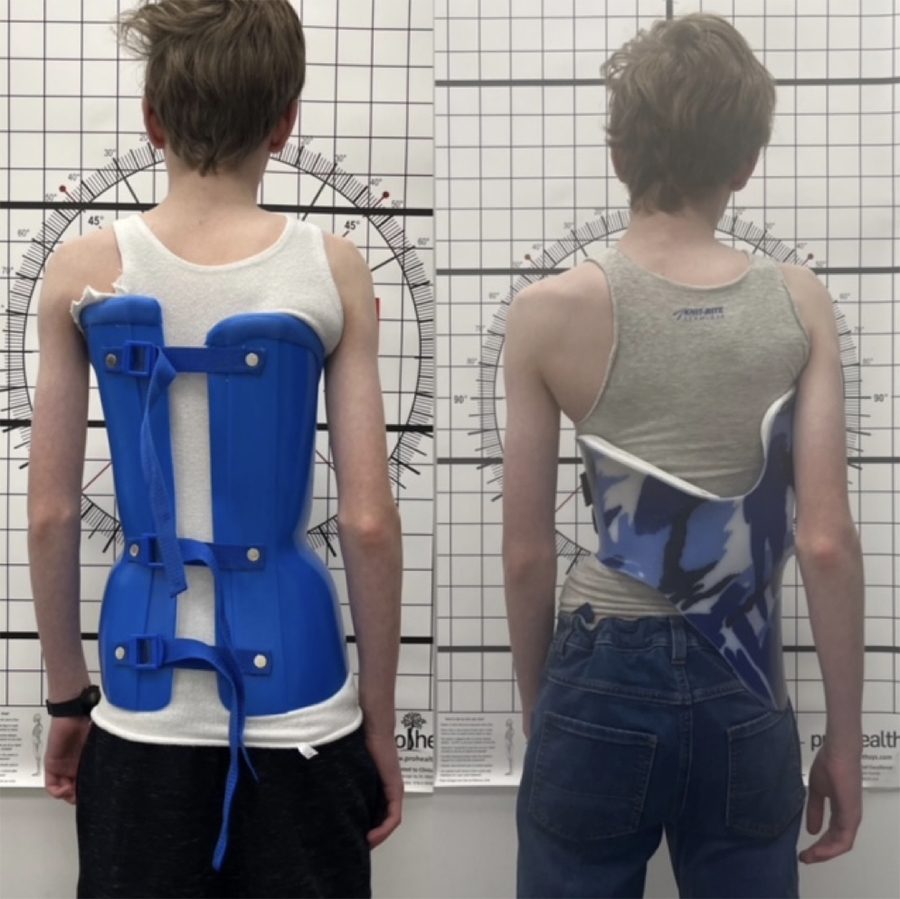
At the original diagnosis, Beck had a Risser score of 0 (meaning he had a lot of growing to do); he is now Risser 4, which means he may only have to continue wearing his brace for a couple of years, during which time we would expect further improvement, and then his scoliosis treatment will be complete with no need to resort to surgery.
Are you concerned that your child may have scoliosis?
Especially in young people, spotting the early signs of scoliosis is important—as is seeking early treatment. These are the warning signs to look out for:

Visual signs of Scoliosis
You can find out more about the visual signs of scoliosis here.
Get in Touch
Find out more information about the LOC Scoliosis Brace
If you think your child, adolescent or adult family member has scoliosis, you can contact LOC directly to arrange a consultation at one of our scoliosis clinics.
If your child has recently been diagnosed with Scoliosis or you think they are showing signs of the condition, please contact us
-
Scoliosis is a condition where there is an abnormal curvature of the spine. It is a three-dimensional condition with deviation of the vertebrae in the sagittal, coronal and transverse planes.
-
The simple answer is no. Scoliosis is not hereditary, there is no single known gene responsible for the condition.
-
Most of the patients LOC see have what is termed idiopathic scoliosis – which means that there is no known medical cause for the condition. What we do know is that scoliosis tends to occur during periods of rapid body growth and adolescents account for over 80% of all diagnosed cases in children.
-
Scoliosis affects 2-3% of the population. According to the NHS, around three or four in every 1,000 children will require treatment for scoliosis. It is most typically seen in children between the ages of 10 and 15.
-
In terms of an official diagnosis, scoliosis is confirmed with an x-ray, which is typically followed up with an MRI scan. A key determining factor that is used when proposing a treatment pathway, is what is known as the Cobb angle. This was invented by Dr John Cobb in 1948. It is now the standard measurement to determine and track the progression of scoliosis. A Cobb angle describes the degrees of deviation from straight in the spine. This can be measured by our clinicians, so please feel free to send x-rays to us for assessment.
-
There are visual clues that a parent should be aware of: See our visual signs and symptoms of scoliosis post for more information.