

We’re happy to answer any questions you might have, with no commitment to proceed with treatment.
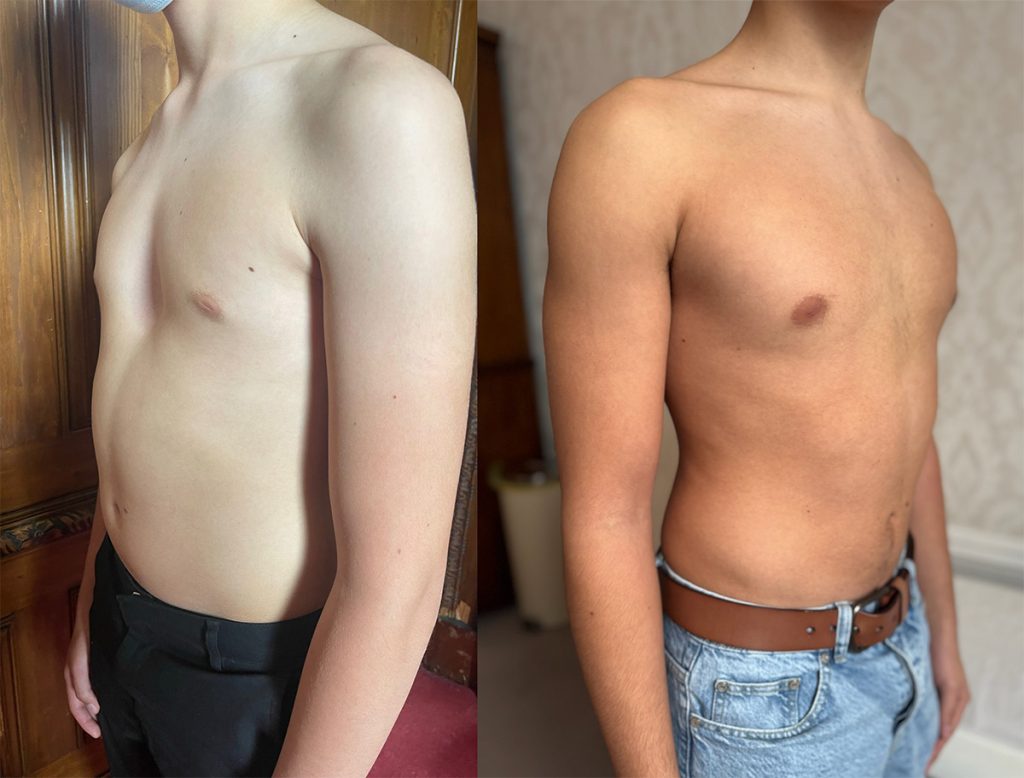
Alex achieved 100% correction of his chest shape thanks to vacuum bell treatment
Alex achieved 100% correction of his chest shape thanks to vacuum bell treatment
- Patient name: Alex
- Treatment: Pectus excavatum treatment
- Age: 14
- Orthotist: Sam Walmsley
- Travelled from: United Kingdom

With our non-surgical treatment plan, Alex achieved 100% chest correction in just two years with a vacuum bell, a custom rib brace and a dedicated exercise programme.
When he was 13 years of age, Alex had just showered and looked in the mirror and was worried by the appearance of his chest. It was indented, and his ribs were sticking out. His family sprang into action and searched online to see if they could find out what the problem was.
They concluded that Alex had something called pectus excavatum (PE), sometimes referred to as’sunken’ or ‘funnel’ chest; he also had flared ribs. Pectus excavatum happens when the chest bone is pushed inwards by an overgrowth of cartilage between the ribs and the breastbone.
The condition tends to become exaggerated during puberty, where growth spurts cause the cartilage and bones to grow rapidly. The sternum becomes caved in, looking “dented” or “sunken.” The ribs often tend to flare out due to the excavatum area sinking inwards. The cause of pectus excavatum is unknown, though there’s thought to be a hereditary aspect as patients with pectus usually have family members who have had the same condition. In Alex’s case, his grandfather had it.
While searching for potential treatments for Alex, his parents found that the NHS seemed only to be offering a surgical solution to PE, which was not something the family wanted to consider. But in their online searches, they found the London Orthotic Consultancy and discovered our clinic in Bristol, close to where they lived.
Initially, they arranged a free online consultation with Sam Walmsley, director of LOC, who had introduced the concept of non-surgical treatment for pectus conditions to the UK in 2010. Satisfied that the treatment was suitable, they booked a face-to-face consultation for May 2022.

Alex’s father, Lee, remembers a key moment in that consultation: “Sam asked Alex to hold his breath and see if he could push his chest out, it’s called the Valsalva manoeuvre, and it’s a way of increasing pressure on the chest. This was a game changer for us as it demonstrated that Alex’s chest shape could be improved. We were then able to see what his chest would look like after treatment, which was quite extraordinary. Alex had a clear idea of the end goal.”
Our treatment protocols for Alex included a mini vacuum bell (to treat the PE) and a bespoke brace to push his flared ribs back in, plus individual exercises and participation in online classes with Alva Yoga. Both the vacuum bell and the rib flaring brace (or dynamic chest compressor) have strict wearing protocols, the brace at the start of treatment should be worn most of the day and night.
At school, Alex did not tell his friends that he was wearing a brace. It was winter so it was possible to hide it under layers of clothing and just take it off for sports. Alex’s adherence to both the required wear times and exercise programme were an important part of the success of his treatment, Alex even set up his own gym in their garage so he could do his exercises in peace.
After two years, the end result a completely flat chest, 100% correction. Alex comments: “To be frank it was not easy at the beginning, but you just have to put the time and effort in, and the end result speaks for itself. Sam was great, always supportive, and would sort out any issues I had with my brace quickly. I am so pleased with how my chest looks now.”
Lee adds:” The treatment is really pretty straightforward considering what had to be achieved. I would totally recommend it to parents whose children have the same condition.”
If you or your child is concerned about their chest shape, book a free online pectus appointment with one of our clinicians today.