

We’re happy to answer any questions you might have, with no commitment to proceed with treatment.
Ada’s brachycephaly improves with helmet therapy
Baby Ada’s severe brachycephaly improves thanks to LOC’s cranial remoulding helmet therapy.
- Patient name: Ada
- Treatment: Plagiocephaly treatment
- Age: 6 months
- Orthotist: George Coles
- Travelled from: United Kingdom
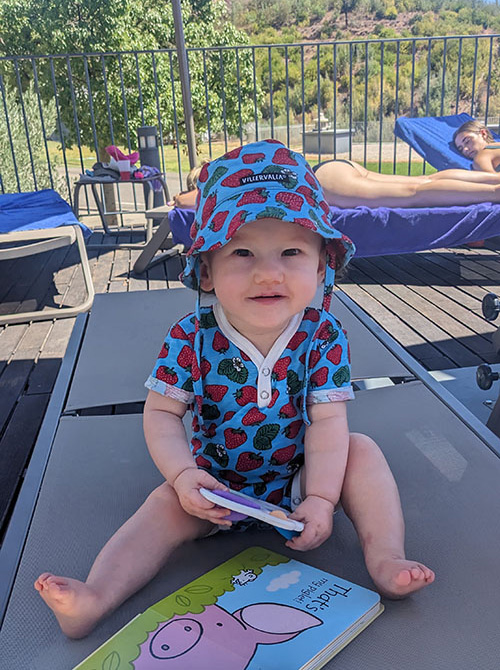
Ada’s severe brachycephaly has been resolved thanks to LOC’s cranial remoulding helmet therapy.
Ada was a premature baby, had a congenital heart defect and Club Foot. Ada’s mother, Constance, first noticed something was wrong with Ada’s head shape when she was two months old but with everything else that was going on it was not until she was 6 months old that Constance felt it was time to seek treatment. Online research quickly established that Ada had a condition known as Brachycephaly, similar to positional plagiocephaly, but different. Derived from the Greek ‘short head,’ it means the shape of the skull is shorter than average.

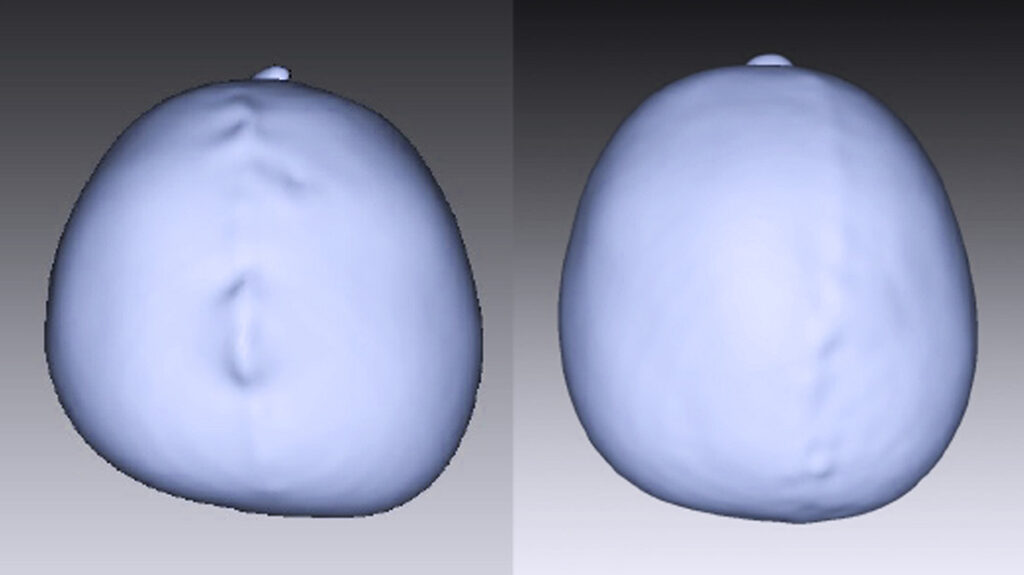
In January, Ada was assessed by George Coles, one of LOC’s cranial clinicians. At this initial assessment, various measurements are taken to establish the severity of the condition; one such measurement is used to establish the cephalic ratio. This measures the width of the skull divided by the length of the skull. The top end of the normal range is 89%, whereas Ada’s was 104%. Ada’s head shape was indeed severe.
Constance explains: “Because of the severity of Ada’s brachycephaly, George recommended that Ada was treated with the original LOCband design rather than the new 3D-printed LOCband Lite, as he said there will simply be more room for growth to attain a normal head shape. George was great, really informative every step of the way and did not over-promise. Ada was not bothered by the helmet at all; the whole treatment was seamless, compared with what we were going through with Ada’s other medical problems. And we were really pleased with how quickly the treatment worked (7 months). The visual improvement in Ada’s head shape is really quite dramatic.”
At discharge, Ada’s cephalic index was 91% compared to 104% pre-treatment.
Worried about your baby’s head shape? Fill out our free Flat Head Diagnosis Form or, to book a free consultation with an orthotist, contact us.
-
The LOCband is non-invasive and works by applying gentle, constant pressure over the areas of the baby’s skull that are most prominent while allowing unrestricted growth over the flattened areas. The band consists of a soft foam layer inside a thermoplastic shell. As the baby grows, the band will be adjusted frequently to gently guide the skull into a more symmetrical shape.
-
The optimum age for treatment is between four and seven months. This is because the skull is most malleable at this age and improvements to head shape tend to take less time and are more dramatic. That is not to say that helmet therapy should be ruled out if the baby is older than seven months. Routinely, babies up to the age of 16 months can be treated very successfully. The cut off age is around 18 months when the fontanelles (soft spots on the head) are no longer malleable. As babies grow and develop at different rates, it is always worth checking if you are not sure. There have been cases where a baby’s fontanelles have not fused yet by the age of 18 months, who have achieved successful, but less-marked results with cranial remoulding therapy.
-
Yes – All babies that have completed their course of treatment with us have achieved a measurable improvement in head shape. However, you don’t have to take our word for it. Recent independent research conducted by a University Hospital in Germany has endorsed the treatment for babies with moderate or severe plagiocephaly. A larger, retrospective study has just been published that found complete correction was achieved in 94.4% of babies treated with helmet therapy. The results were conclusive: repositioning achieved acceptable correction in 77.1% of cases, but 15.8% were moved onto helmet therapy because re-positioning was not working. Meanwhile, 94.4% of the infants who started in the helmet-treated group achieved full correction, as did 96.1% of those who were transferred from the repositioning group into the helmet-treated group. Further information can be found on our Plagiocephaly Research page.
-
This is very much dependent on how fast your baby is growing. The faster the growth, the more frequently your baby will be seen so that the helmet can be adjusted. In general, reviews will happen at two to four-week intervals.
-
The price of treatment covers: