
We’re happy to answer any questions you might have, with no commitment to proceed with treatment.
Risser scale in scoliosis treatment
With LOC’s Scoliosis brace, the main goal is to correct the curve by straightening the spine and holding it in place. Normally with scoliosis patients, their vertebrae are compressed asymmetrically, and this inhibits growth on one side while not inhibiting growth on the othe
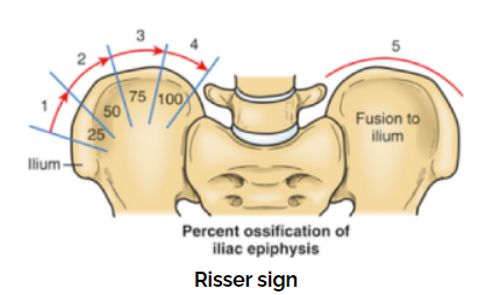
The Risser scale (named after Dr. Joseph C. Risser) is a measurement of skeletal maturity or growth; it utilizes the fact that as a person’s skeleton matures during adolescence bone starts to form on the outer part of the iliac crest (upper edge of the pelvis) and calcifies inward along the ridge. After this bone formation is complete, the new bone growth fuses to the hip bone and this fusion is believed to correspond with full skeletal maturity. So, the degree of bone growth can be used to determine what stage of skeletal maturity has been reached.
Conveniently, the same X-ray that is taken to measure a patient’s Cobb angle can be used to determine this. A scale of 0–5 is used, where Risser 0 shows a significant amount of growth is still to happen while Risser 5 indicates full skeletal maturity.
Using the information below, one can determine the stage a patient has reached.
Risser 1 typically equates to the beginning of puberty, 3 is normally around mid-puberty, and 5 is a fully grown adult. Boys and girls start puberty at different ages, which normally means they finish at different ages. With girls normally starting at 11-12 and finishing at 16-17 and boys starting at 12-13 and finishing at 17-18.
Are you concerned that your child may have scoliosis?
Especially in young people, spotting the early signs of scoliosis is important, as is seeking early treatment. These are the warning signs to look out for:
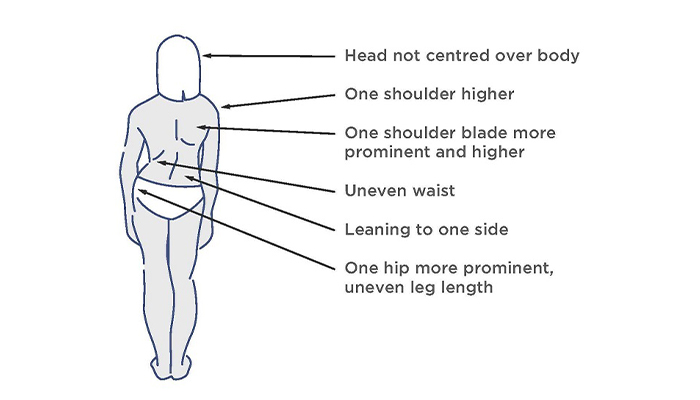
You can find out more about the visual signs of scoliosis here.
Get in Touch
Find out more information about the LOC Scoliosis Brace
If you think your child, adolescent or adult family member has scoliosis, you can contact LOC directly to arrange a consultation at one of our scoliosis clinics.
If your child has recently been diagnosed with Scoliosis or you think they are showing signs of the condition, please contact us
BOOK APPOINTMENT
For Plagiocephaly free photo diagnosis, please upload images in accordance with our plagiocephaly photo guide (max. 2mb each).
For Pectus, please follow our pectus photo guide (max 2mb each).