

We’re happy to answer any questions you might have, with no commitment to proceed with treatment.
Pectus carinatum
Pectus carinatum is a chest wall deformity that affects approximately 1 in 1,500 people.

What is pectus carinatum?
Pectus carinatum is a condition where the breastbone (sternum) pushes outward due to excess cartilage growth. It’s a congenital condition, meaning it’s present from birth, but it often becomes more noticeable during adolescence as the body grows. It’s sometimes referred to as ‘pigeon chest.’
Often, both sides of the ribs are affected. In other cases, it can appear asymmetrical, with one side more noticeable than the other.
It is not to be confused with pectus excavatum, when the chest sinks inward.
Symptoms
- breastbone looks pushed out: in the middle of your chest
- chest asymmetry: one side may stick out more than the other.
- rib flaring: your lower ribs may stick outward, exaggerating your chest shape
It is possible to have a chest shape that has characteristics of both pectus carinatum and excavatum, where part of the chest protrudes, whereas the other dents inwards.
The severity and appearance of the condition can vary from person to person.
Other complications
Most people with pectus carinatum do not have secondary symptoms, though some people report:
- chest pain where the breastbone sticks out
- shortness of breath, particularly when exercising
- stiff chest wall
However, not everyone may experience these.

Psychological impact
Patients can find the psychological aspect of having pectus carinatum the hardest to deal with. Many patients, especially teenagers, may worry about their appearance and about others noticing their chest shape. This can lead to:
- social anxiety
- body image issues
- feeling more self-consciousness
- low confidence
- low self-esteem
- withdrawal from activities you used to enjoy, for example swimming
Causes
The exact cause of pectus carinatum is not fully understood, but it’s mainly because the cartilage between the ribs and the breastbone grows too much, pushing the breastbone outward. There’s thought to be a genetic factor as it often runs in families, but the specific gene that causes it hasn’t been found yet. Sometimes, pectus carinatum is also linked to other conditions like scoliosis or Marfan syndrome.
Diagnosis
A diagnosis is usually made during a physical examination. In some cases, imaging such as X-rays or CT scans may be used to assess the severity and rule out other conditions.
Pectus carinatum chest shape examples
Treatment
Treatment options depend on these factors:
- your age
- how severe your pectus carinatum
- the flexibility of your chest
Non-surgical treatment
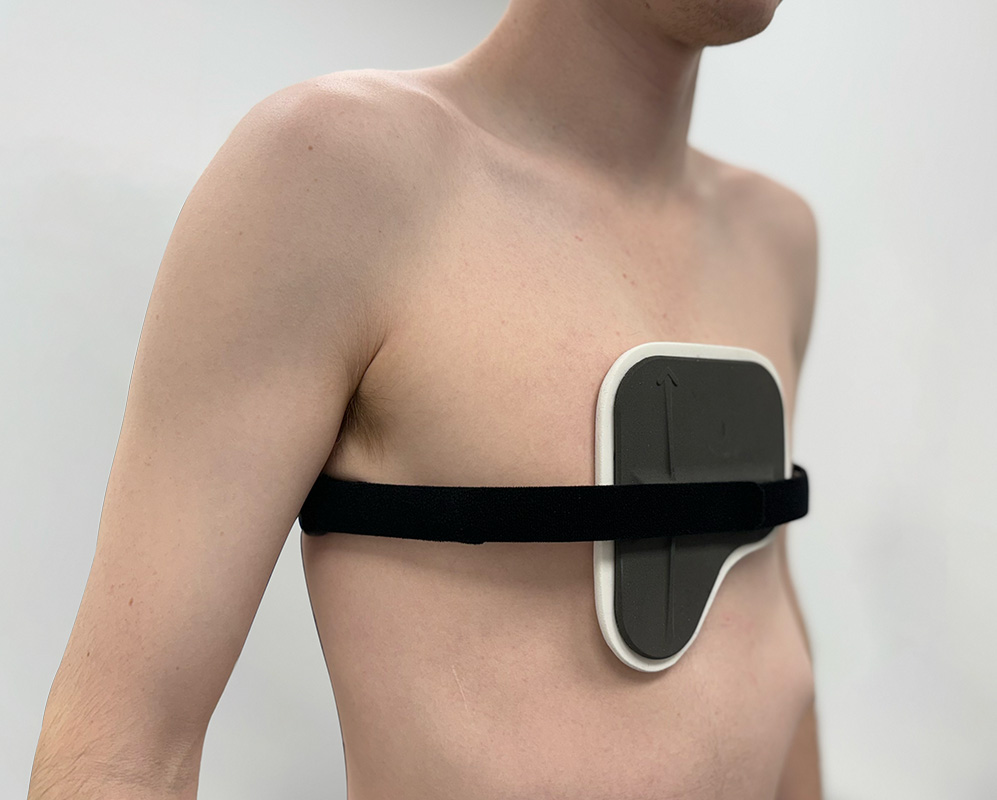
- Dynamic chest compressor: a custom-made orthotic brace that applies gentle pressure to gradually reshape the chest over time.
- Rib flaring brace: a bespoke brace that works in the same way as the dynamic chest compressor but focuses on applying pressure to the rib cage.
Surgical treatment
Ravitch procedure or modified Ravitch procedure: surgery that involves making an incision across the chest and removing the excess rib cartilage on each side, before repositioning the breastbone to a flatter position.
Non-surgical bracing is a very effective solution for pectus carinatum. Though surgery may still be recommended in more severe cases.
See our pectus carinatum treatment page
Improve your chest shape with our slimline pectus brace
Correct your chest shape without surgery with the slimline dynamic chest compressor and rib flaring brace. We’re proud to have pioneered this treatment in the UK since 2010 and have achieved outstanding results for our patients.