
We’re happy to answer any questions you might have, with no commitment to proceed with treatment.
09 November 2020
OSKAR launch
LOC to launch OSKAR (Optimal Segmental Kinematics and Alignment Approach to Rehabilitation) Framework to CMSUK 2020 Delegates
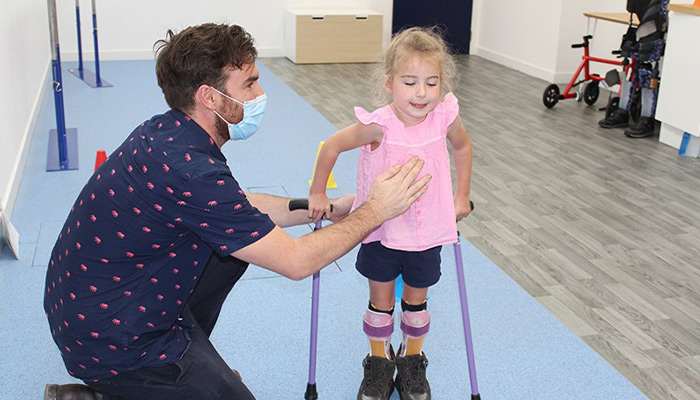
LOC’s Director and Lead Orthotist, Sam Walmsley, has been invited to join world-renowned and key NHS speakers at the CMSUK virtual conference in November 2020. He will share his experiences of working with an orthotic framework for treating children with lower limb neurological conditions, called OSKAR (Optimal Segmental Kinematics and Alignment Approach to Rehabilitation). Here, Sam explains what OSKAR involves and the positive impact it’s having on his patients.
“Usually, when I say OSKAR to people, they think I’m talking about the Hollywood film awards! But in my world, OSKAR represents a different gold standard – not for acting, but for orthotic care for children with lower limb neurological conditions, such as cerebral palsy and spina bifida.”
OSKAR is a framework originally developed by Elaine Owen MBE MSc SRP MCSP, in cooperation with our team at LOC. Elaine is a world-renowned physiotherapist whose work has challenged conventional wisdom and rewritten textbooks. We have worked with her for many years and have seen extraordinary results in many of our patients. As a result, we set up our first OSKAR clinic at our Kingston-upon-Thames clinic in 2015 and have since set up a second at the University of Salford in Manchester. Usually, we operate a clinic from the gait laboratory in the university’s teaching hospital. During Covid-19, though, we have temporarily moved orthotic treatment to our Manchester Clinic.
So, what is OSKAR and how does it work?
In simple terms, it’s a comprehensive treatment plan tailored to the individual’s goals and requirements. It starts with a patient assessment in our video vector Gait Laboratory.
Here, we assess a child’s gait and walking patterns by filming their movement and taking lots of digital photographs. We do that both barefoot and using any existing orthotics to get a complete picture of an individual’s range of movement. We’ll also look at the bone and joint alignment, muscle strength and stability.
Related Video
We then use the International Classification of Functioning, Disability and Health (ICF) guidelines as a framework to measure and assess a patient’s musculoskeletal progress against specific, agreed goals. So, for example, parents might be looking to help their child stand independently, or move around nursery safely, or even play football with their friends. Combining our Gait Laboratory data with these goals allows us to create a customised orthotic treatment plan. And, because we document everything, we have a clinical baseline from which to work and assess progress over time.
The centrepiece of the treatment plan is an orthotic prescription that we manufacture on-site. Our manufacturing tools can create precise orthotics using evidence-based work that Elaine has conducted on computer algorithms that have established good patterns of walking.
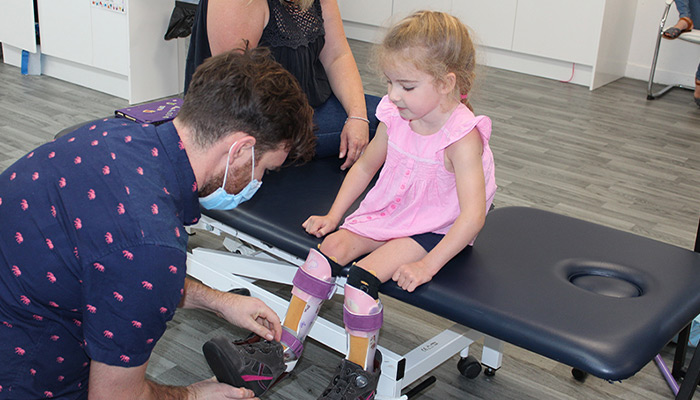
Once the new orthotics are made, we then conduct a fitting. This involves a ‘tuning up’ process where we bring the patient back into the Gait Laboratory to reassess their movement in their splints, tweak the prescription if necessary and keep repeating that process until everyone is happy that the child is comfortable and that the orthotics fit their shoes.
Shoes are incredibly important in this process! Often, patients come to us wearing orthotics made elsewhere that are causing discomfort because they haven’t been tuned to the shoe. It doesn’t have to be a special shoe, either. It could be a trainer from Sports Direct. But the important point is that we develop the orthotic with that shoe in mind to ensure maximum comfort. This also means that parents don’t have to worry about anything other than their child’s progress.
-
We have the following facilities and amenities at our Kingston Upon Thames location: We also have the Gait Laboratory for orthotics patients and Onsite Manufacturing for speedy turnarounds and adjustments whilst you wait.
-
We have the following facilities and amenities at our Cambridge location:
-
We have the following facilities and amenities at our Bristol location: For more information, visit Litfield House Medical Centre.
-
We have the following facilities and amenities at our Romford location: Parking: There is NO parking directly outside the clinic. These spaces are reserved for residents. The nearest parking can be found at Billet Lane public pay & display opposite Queens Theatre, a 2-minute walk from the clinic. Click here for more information about Best Health Clinic
-
LOC’s clinic is based in the University of Salford’s Podiatry Department and provides treatments for orthotics, scoliosis, pectus deformities, positional plagiocephaly and club foot. It is also the base for LOC’s northern OSKAR clinic which is run by Sam Walmsley, clinical director of LOC, in conjunction with Elaine Owen MBE MSc SRP MCSP.
-
Due to COVID-19, we have had to temporarily close the Salford clinic and are operating out of another clinic in Bolton. 508 Blackburn Rd, Astley Bridge, Bolton BL1 8NW For more information, please visit The Good Health Centre